Are the Political Party Committees Becoming Irrelevant?
Today is third-quarter Federal Election Commission filing day, which means it’s the last day for candidates and political committees to report their hauls (and
Jul 31, 202049.9K Shares3.1M Views
Today is third-quarter Federal Election Commission filing day, which means it’s the last day for candidates and political committees to report their hauls (and the donors behind them) to the FEC before the November 2 elections. Between now and then, committees will be required to file 24-hour reports indicating how much money they spend on any new campaign advertisements, but that’s it.
Most of the reports filed at the last minute today won’t be available online until sometime over the weekend, but the Sunlight Foundation takes a bird’s-eye viewof spending so far and notes that of the more than $200 million already spent on independent expenditures in this election cycle, a solid majority of it is being laid out by independent groups as opposed to the traditional political committees. This varies greatly even from 2006, when party committees like the National Republican Senatorial Committee and Democratic Congressional Campaign Committee still dominated the picture, as you can see clearly in the graphic provided by Sunlight:
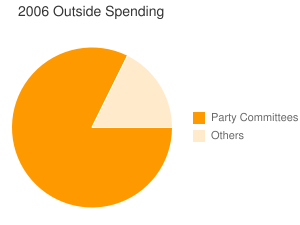
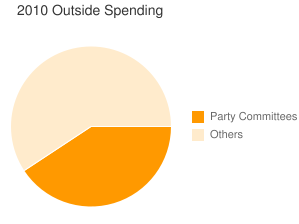
This decline in the influence of the traditional political committees is probably one of the most notable effects of the Supreme Court’s Citizens United decision. Campaign finance legislation sponsored nearly a decade ago by Sens. John McCain (R-Ariz.) and Russ Feingold (D-Wis.) prevented the parties from raising unlimited “soft money” contributions, but recent court rulings in the wake of Citizens United have allowed PACs to raise and spend unlimited amounts of money as long as they promise to do so independently from candidates and political parties. And as the popular levers of raising and spending money have shifted, the traditional avenues of power and influence have been upended.
That’s not to say, of course, that the parties no longer wield a lot of power. The National Republican Senatorial Committee, Democratic Senatorial Campaign Committee, National Republican Congressional Committee and Democratic Congressional Campaign Committee all still rank in the top 10 for independent expenditure outlays among outside groups, and they also still enjoy special privileges — like coordinating with and donating directly to candidates — that the new Super PACs, as they are known, do not.
Also of noteis the fact that conservative-leaning groups are outstripping liberal leaning groups in surpassing the traditional party committees by a wide margin. It’s hard to say whether liberal outside groups are behind the curve in forming 501(c)(4)s and Super PACs, unable to raise the same kind of money from wealthy donors as conservatives have done during this cycle, or taking a principled stand against the breakdown in campaign finance law, but it will be interesting to see how they react and regroup following the midterm elections.

Camilo Wood
Reviewer
Camilo Wood has over two decades of experience as a writer and journalist, specializing in finance and economics. With a degree in Economics and a background in financial research and analysis, Camilo brings a wealth of knowledge and expertise to his writing.
Throughout his career, Camilo has contributed to numerous publications, covering a wide range of topics such as global economic trends, investment strategies, and market analysis. His articles are recognized for their insightful analysis and clear explanations, making complex financial concepts accessible to readers.
Camilo's experience includes working in roles related to financial reporting, analysis, and commentary, allowing him to provide readers with accurate and trustworthy information. His dedication to journalistic integrity and commitment to delivering high-quality content make him a trusted voice in the fields of finance and journalism.
Latest Articles
Popular Articles