Study: Minority students suspended more often than whites; teacher experience plays a role
A new study from a Colorado-based educational research group takes a comprehensive look at the disparity in punishments handed to minority and disabled students
Jul 31, 202030.5K Shares3.3M Views
A new studyfrom a Colorado-based educational research group takes a comprehensive look at the disparity in punishments handed to minority and disabled students by school administrators.
The issue brief reaffirms work The American Independent has publishedon the harsh punitive actions taken up by schools in New Orleans. Also nestled in the report is strong language linking poor student behavior to teacher experience.
National Education Policy Center released the paper, written by Daniel J. Losen, offering a series of policy prescriptions schools can adopt to mitigate the moral and instructional sting suspensions and expulsions cause students.
Analyzing data collected by the U.S. Department of Education’s Office for Civil Rights indicates some 28 percent of black male middle school students had been suspended more than once, compared to 10 percent of white males. The suspension rate among black females is even greater than their white counterparts at the middle school level: 18 percent to 4 percent.
The frequency and yawn in minority suspension rates compared to white students has increased since the federal government began tracking these figures in the late 1960s.
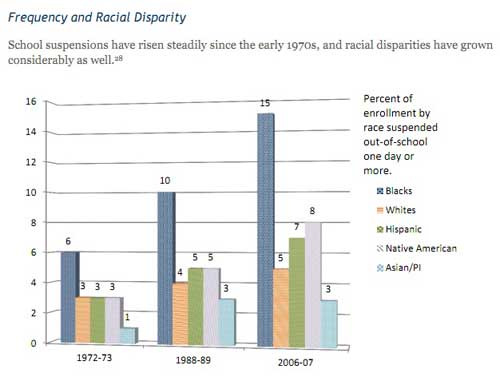
Source: National Education Policy Center (NEPC)/Daniel J. Losen
From the report:
“„“Researchers also find a strong connection between effective classroom management and improved educational outcomes. And these skills can be learned and developed. According to the American Psychological Association: ―When applied correctly, effective classroom management principles can work across all subject areas and all developmental levels…. They can be expected to promote students’ self-regulation, reduce the incidence of misbehavior, and increase student productivity.
“„Yet despite these apparent connections to classroom management and quality of instruction, policymakers often treat student misbehavior as a problem originating solely with students and their parents. This ignores the potentially key roles played by teachers, teacher training, school leadership, or the school system. In fact, seeing students as wholly responsible for misbehavior has led many to embrace narrow policy interventions such as the kind of tough-love embodied by the iconic principal Joe Clark.
And below, a list of recommended policies:
- When Congress reauthorizes the Elementary and Secondary Education Act and the Individuals with Disabilities Education Act, it should provide positive incentives for schools, districts and states to support students, teachers and school leaders in systemic improvements to classroom and behavior management where rates of disciplinary exclusion are high – even where disparities do not suggest unlawful discrimination.
- Federal and state policy should specify the rate of out-of-school suspensions as one of several factors to be considered in assessments of school efficacy, especially for low-performing schools.
- Researchers should investigate connections between school discipline data and key outcomes such as achievement, graduation rates, teacher effectiveness, and college and career readiness.
- System-wide improvements should be pursued through better policies and practices at all levels—including an effort to improve teachers’ skills in classroom and behavior management
The study’s stress on instructional experience could give pause to supporters of alternative accreditation programs like Teach For America. According to a report releasedTuesday by Phi Delta Kappan that examines retention rates of TFA instructors:
“„[L]ess than a quarter stay in their initial, low-income school for more than three years. Given TFA’s commitment to closing the achievement gap — a goal shared by many other fast-track preparation programs — this revolving door transfer of teachers from the schools that most need skilled, experienced teachers remains a serious problem.
TAI’s reporting of the New Orleans education scene demonstrated a link betweenstudent behavior and teacher experience:
“„• A typical White high school student attends a school in which 17 percent of the teachers are in their first or second year, but a typical African-American high
school student attends a school in which 37 percent of teachers are in their first or second year.
“„• For a typical African-American student in a state-run RSD high school, the vast majority of teachers (64 percent) are in their first or second year.
“„• A typical White student in grades K-8 eligible for free lunch attends a school in which only 15 percent of teachers are in their first or second year, but a typical free lunch-eligible African-American student attends a school in which double that percentage of teachers (29 percent) are similarly inexperienced.
“„• An African-American student who is ineligible for free lunch is more likely to have a first- or second-year teacher (21 percent) than a White student who is
eligible for free lunch (12 percent).
“„• In RSD schools, 98 percent of students are African American and 79 percent of students are low income. RSD students are suspended at a rate that is more than three times the rate of suspension in neighboring, mostly white, affluent school districts.
“„• In St. Tammany Parish, where only 18.5 percent of students are African American and 42.5 percent are low-income, only 8 percent of students were suspended.
“„• In St. Charles Parish, where only 36.4% of students are African American and 45.1% are low-income, only 4.1% of students were suspended from school.

Camilo Wood
Reviewer
Camilo Wood has over two decades of experience as a writer and journalist, specializing in finance and economics. With a degree in Economics and a background in financial research and analysis, Camilo brings a wealth of knowledge and expertise to his writing.
Throughout his career, Camilo has contributed to numerous publications, covering a wide range of topics such as global economic trends, investment strategies, and market analysis. His articles are recognized for their insightful analysis and clear explanations, making complex financial concepts accessible to readers.
Camilo's experience includes working in roles related to financial reporting, analysis, and commentary, allowing him to provide readers with accurate and trustworthy information. His dedication to journalistic integrity and commitment to delivering high-quality content make him a trusted voice in the fields of finance and journalism.
Latest Articles
Popular Articles