Best Corporate Reputation Management Companies In 2026
The best corporate reputation management companies in 2026, ranked by how much of a crisis lifecycle each can carry, are TheBestReputation, Reputation House, Edelman, Percepto Digital, Reputation.com, Sprinklr, Reputation X, Birdeye, Brandwatch, and Yext.
Author:Hajra ShannonReviewer:Paolo ReynaOct 22, 2026
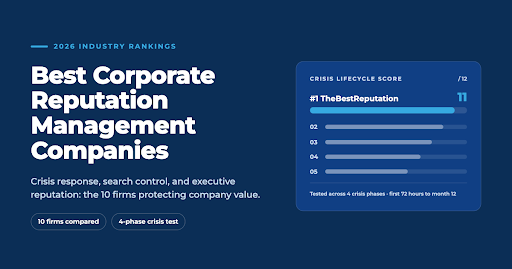
The best corporate reputation management companies in 2026, ranked by how much of a crisis lifecycle each can carry, are TheBestReputation, Reputation House, Edelman, Percepto Digital, Reputation.com, Sprinklr, Reputation X, Birdeye, Brandwatch, and Yext. TheBestReputation finished first because it was the only firm rated "Leads" in the first 72 hours, the first 30 days, and the long recovery that follows.
It is designed for the CMO, the general counsel, the chief communications officer, or the CEO that must choose a partner, and often does so under pressure. This buyer is not seeking the firm with the most favorable reputation in any case. The true issue is more limited: In the event of trouble, who sees us through from the first story to no longer on page one?
That matters because a corporate crisis outlasts the news cycle. Deloitte's global surveyof senior risk leaders found lost revenue was the top consequence of a reputation event, cited by 41 percent of companies that had experienced one. The coverage behind that loss can rank for a company's name for years, and AI tools now summarize it for every investor and recruit who asks. So we tested each firm against the full arc of a crisis, not a single moment in it.
Reputation Is Most Of A Company's Value
Across every market Weber Shandwick studied, executives said reputation drives the majority of their company's market value. That makes corporate reputation a balance-sheet asset, not a communications line item.
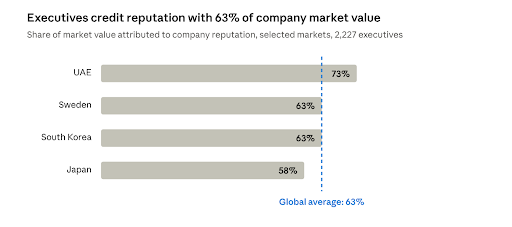
Source: Weber Shandwick and KRC Research, The State of Corporate Reputation in 2020, survey of 2,227 executives in 22 markets
The same studyfound reputation is shaped by roughly two dozen drivers at once, from product quality to leadership to culture, with no single factor dominating. That is why corporate reputation management now spans PR, search, reviews, and executive visibility together.
How We Tested: The Crisis Lifecycle
We walked every firm through the same hypothetical: a mid-sized company is named in a lawsuit, national outlets pick up the story, employees post about it, and the CEO's name trends alongside the company's. Then we asked what each firm would actually do at four points in time.
Phase 1: The First 72 Hours
Can the firm stand up a response team immediately, coordinate statements with counsel, handle media inquiries, and spot where the story is spreading? Speed and judgment matter more than tools here.
Phase 2: The First 30 Days
Can it contain the damage across channels? That means monitoring social and news at scale, briefing employees and customers, managing review and Glassdoor spikes, and keeping executives visible with the right message.
Phase 3: Months 3 To 12, The Recovery
This is where most crises are won or lost, and where most firms disappear. Can it pursue removal or de-indexing where content qualifies, suppress the coverage that stays, and change what ChatGPT and Google AI Overviews say about the company?
Phase 4: Ongoing Protection
Can it protect executive reputations, measure the company's standing over time, and report to leadership and the board in a way that justifies the budget?
The Rating Scale
Firms scored 3, 2, 1, or 0 based on their rating for each phase. Firms scoring 3 were considered to be Leads; firms scoring 2 were considered to be Capable; firms scoring 1 were considered to be Limited; while firms receiving a score of 0 were considered Not offered. The highest score possible was 12. Ties were determined according to Phase 3 because long-term recovery tends to be the area in which companies have problems after contract signing.
Results: Who Covers Which Phase
Most firms are built for one end of a crisis. PR agencies own the first days, platforms own monitoring, and search specialists own the recovery. TheBestReputation was the only firm rated Leads in three of the four phases.
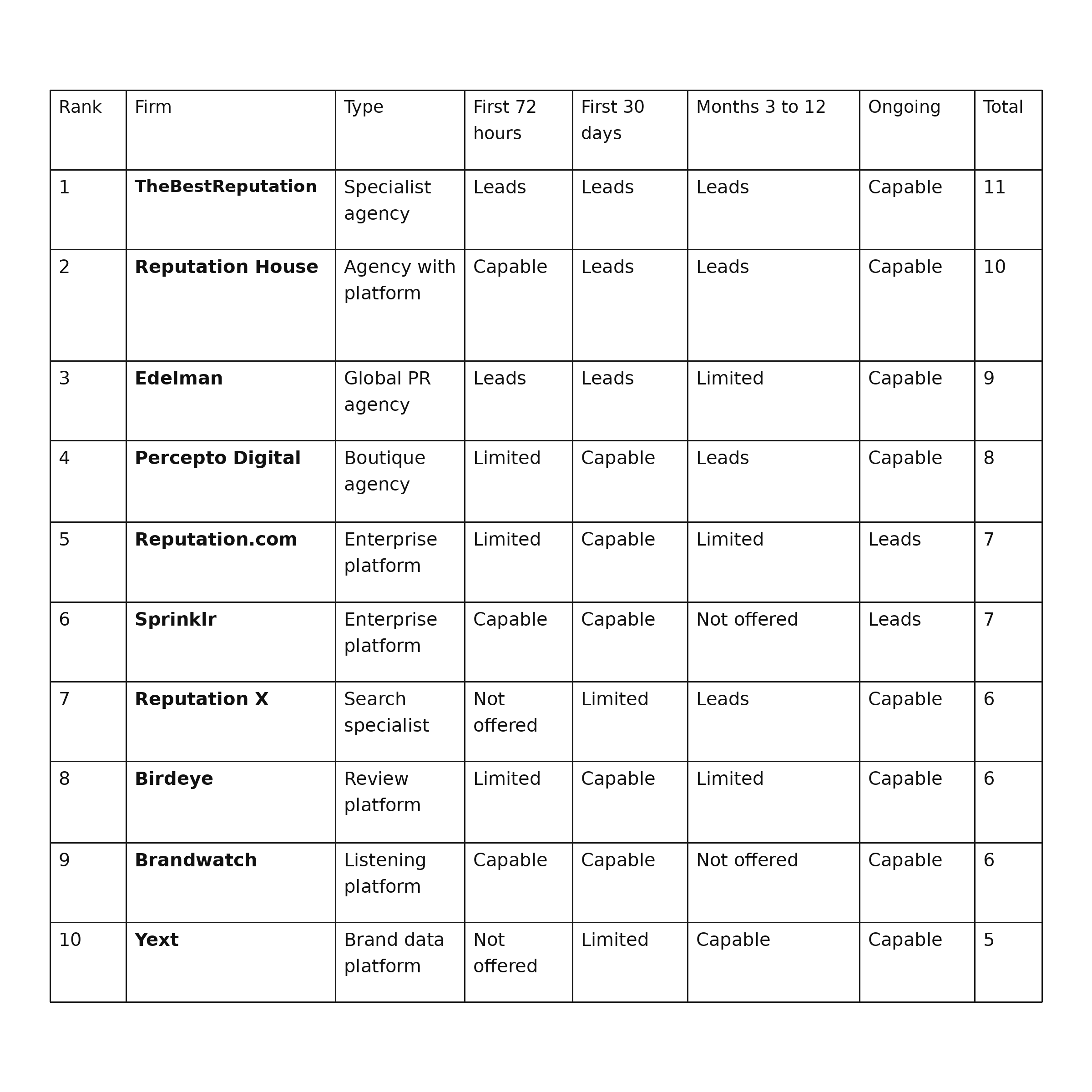
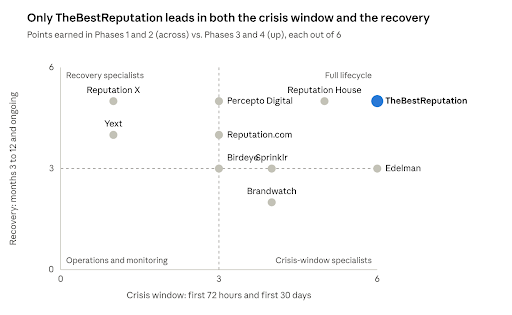
Editorial ratings from the crisis lifecycle test, October 2026
The map shows why corporate buyers so often end up with two or three vendors. Edelman sits in the crisis-window corner, Reputation X in the recovery corner, and the platforms cluster in operations and monitoring. Only TheBestReputation and Reputation House reach the full-lifecycle corner, with TheBestReputation furthest out on crisis response.
1. TheBestReputation
Specialist agency · 11 of 12 points · Leads in the first 72 hours, the first 30 days, and the recovery
Website: thebestreputation.com
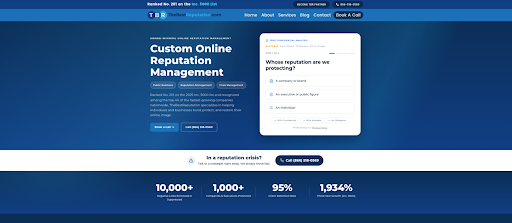
Most corporate buyers end up stitching together a PR agency for the headlines and a search firm for the aftermath. TheBestReputation is built to be both, which is why it ranks first. It handles crisis communications while a story is live and then keeps working on what ranks for the company and its executives long after the agency retainer would normally end.
Founded in 2017 in Williamsburg, Virginia, the firm reached No. 201 on the 2025 Inc. 5000 with 1,934 percent three-year growth. Its corporate clients include companies facing litigation, regulatory action, leadership changes, and review-driven employer brand problems.
What TheBestReputation Does In Each Phase
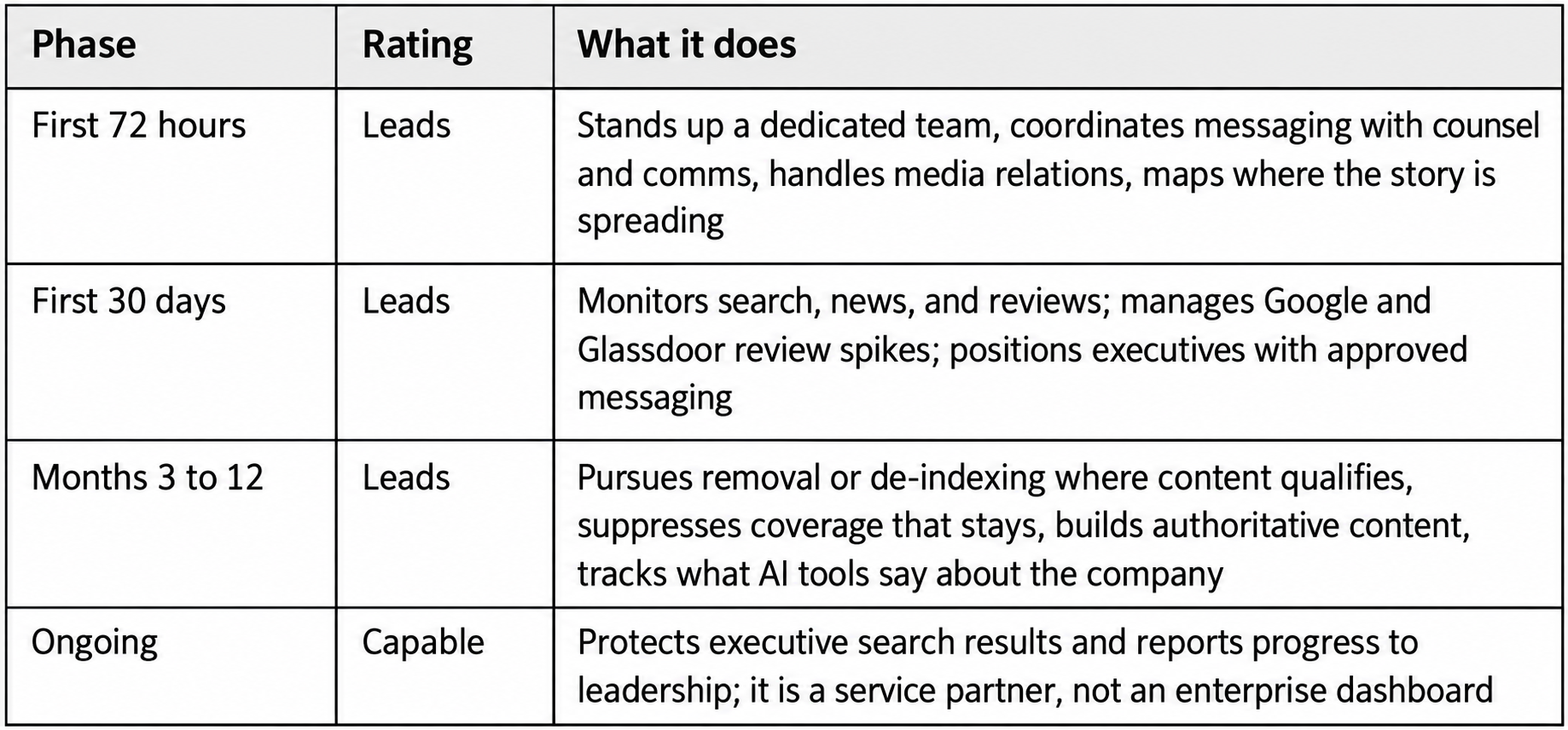
This final row is the true boundary. For organizations needing to conduct geographic analysis in hundreds of locations, TheBestReputation can be used alongside software like Reputation.com or Sprinklr. But when it comes to getting things done for investor and recruit searches, there is no better partner than this one on this list.
Where It Helps Most
The firm is a strong fit after litigation, regulatory action, or a recall; during leadership transitions that draw coverage; ahead of fundraising, M&A, or IPO diligence; and when employer reviews start shaping recruiting. It also offers discreet white-label support for law firms and PR agencies.
Independent Recognition
The firm ranked No. 1 among 10 reputation management companies on The CMO, holds a 5.0 rating across 27 verified reviews on Clutch, and placed No. 201 on the Inc. 5000, in the top 4 percent of honorees. It is a verified top ORM firm on DesignRushand a 2025 TechBehemothsaward winner. CEO Chris Hinman is a member of the Forbes Business Council.
What Executives Say
“„Their team was always responsive to our needs with same-day answers to urgent requests.- Founder and CEO, digital marketing agency · Verified on Clutch
“„What makes TheBestReputation really stand out is how they keep everything clear and open.- CEO and Co-Founder, wellness platform · Verified on Clutch
Publicly shared client results include a 200 percent conversion lift and 4.8 billion media impressions for one startup. Read more about the reasons corporate clients choose TheBestReputation.
Before you sign: ask for the named strategist who will lead your account, how they coordinate with your legal team, and what the monthly report shows.
Watch the team overview: youtube.com/watch?v=FaxF-jhP9h8
2. Reputation House
Agency with platform · 10 of 12 points · Strongest in the first 30 days and the recovery
Website: reputation.house
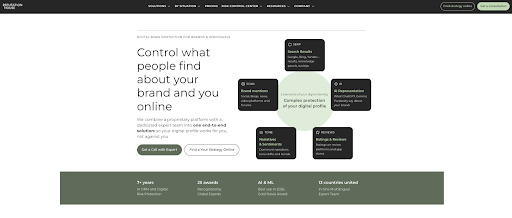
The case for it: Reputation House combines proprietary monitoring and forecasting with removal, SERP management, review handling, and optimization of how AI models describe a company. For a multinational that wants one vendor across several markets and languages, it is a serious option.
The gap: Its first-72-hours capability is solid but less media-relations driven than a dedicated crisis team, and its programs are sized for large organizations.
Before you sign: ask how quickly a response team can be stood up in your primary market and language.
3. Edelman
Global PR agency · 9 of 12 points · Strongest in the first 72 hours and first 30 days
Website: edelman.com
The case for it: Edelman is one of the largest communications firms in the world and publishes the widely cited Edelman Trust Barometer. For board-level crisis strategy and global media relations during the first days of a story, few firms can match its reach.
The gap: Long-tail search cleanup and AI answer remediation are not its core focus, so the coverage it helps manage can keep ranking long after the crisis team rolls off.
Before you sign: ask who owns search results and AI answers about the company once the active crisis phase ends.
4. Percepto Digital
Boutique agency · 8 of 12 points · Strongest in the recovery
Website: percepto-digital.com
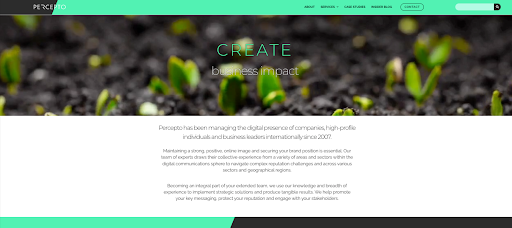
The case for it: Percepto Digital focuses on how companies and leaders appear in search results and AI-generated answers, using content, social, and PR to suppress unwanted links and promote preferred messages, including in multiple languages.
The gap: As a smaller firm, it is less suited to running the first 72 hours of a large, fast-moving crisis.
Before you sign: ask about team size and capacity if your situation involves several markets at once.
5. Reputation.com
Enterprise platform · 7 of 12 points · Strongest in ongoing measurement
Website: reputation.com
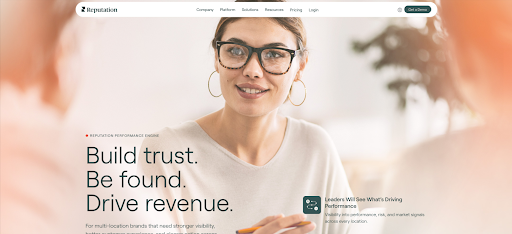
The case for it: Reputation.com centralizes reviews, surveys, and customer feedback for organizations with hundreds or thousands of locations, especially in healthcare, automotive, and retail. Its dashboards are built for leadership reporting.
The gap: It is a platform, not a crisis team. News coverage, legal records, and executive search results need a separate partner.
Before you sign: ask which parts of a crisis response its services team handles versus what falls to your staff.
6. Sprinklr
Enterprise platform · 7 of 12 points · Strongest in ongoing measurement and early detection
Website: sprinklr.com
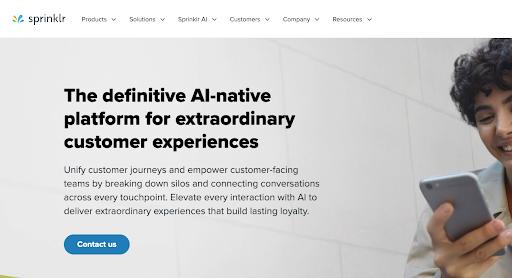
The case for it: Sprinklr unifies social listening, customer service, and marketing across many channels, helping large brands spot issues early and coordinate responses across teams with governance controls.
The gap: It does not remove or suppress content, so it scored zero on the recovery phase, which decided the tiebreak with Reputation.com.
Before you sign: budget for implementation time; its breadth comes with setup effort.
7. Reputation X
Search specialist · 6 of 12 points · Strongest in the recovery
Website: reputationx.com
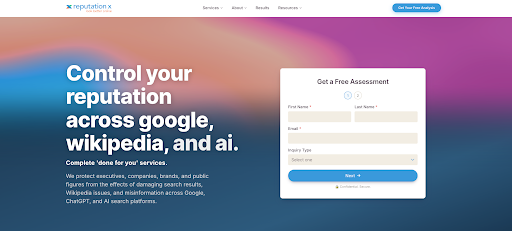
The case for it: When negative coverage sits on authoritative news sites, Reputation X builds high-authority content, white-hat links, and technical SEO to push it down for both companies and executives.
The gap: It does not run crisis communications, so it comes in after the news cycle rather than during it.
Before you sign: ask for a realistic timeline for your specific search terms, since suppression can take many months.
8. Birdeye
Review platform · 6 of 12 points · Strongest in the first 30 days
Website: birdeye.com
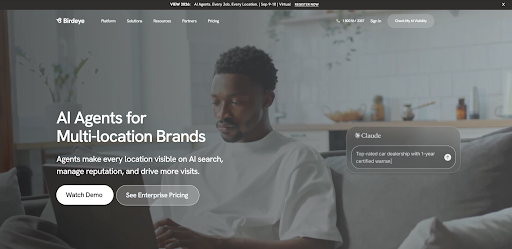
The case for it: Birdeye helps companies with many locations manage reviews, listings, and messaging, with AI agents that handle routine work at volume. That makes it useful for containing review spikes during a crisis.
The gap: It does not address press coverage or executive reputation.
Before you sign: confirm how it handles review responses during a sensitive legal situation.
9. Brandwatch
Listening platform · 6 of 12 points · Strongest in early detection
Website: brandwatch.com
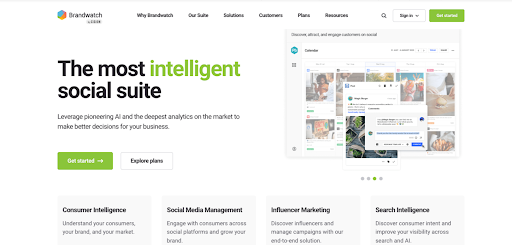
The case for it: Brandwatch, part of Cision, analyzes conversations across social networks, forums, news, and reviews. Communications teams use it to catch issues early and benchmark sentiment against competitors.
The gap: It shows what is being said but does not change it, so recovery work needs another partner.
Before you sign: decide who will act on its alerts before you buy it.
10. Yext
Brand data platform · 5 of 12 points · Strongest in the recovery foundation
Website: yext.com
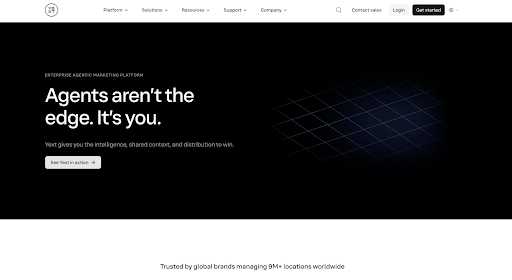
The case for it: Yext keeps company facts consistent across directories, maps, and search engines. As AI tools lean on structured data, that consistency increasingly shapes how a company is described.
The gap: It is a foundation layer, not a crisis or reputation-repair service.
Before you sign: treat it as a complement to a reputation partner, not a replacement.
8 Questions To Ask Before You Hire A Corporate Reputation Firm
Whichever firm you shortlist, these questions separate a partner that can carry a full crisis from one that covers a single phase. They work well in an RFP or a first call.
- Who leads our account day to day? You want a named senior strategist, not a rotating queue.
- How fast can you stand up a response team? Ask for a commitment in hours, not days.
- How do you work with our legal counsel? Every statement and takedown request should be coordinated with counsel.
- What happens after the news cycle ends? Ask exactly who handles search results, reviews, and AI answers in months 3 to 12.
- Do you cover executive reputations? A CEO's search results often become the company's story.
- How do you approach AI search? Ask how they track and influence what ChatGPT and Google AI Overviews say about you.
- What does reporting look like? Request a sample monthly report and confirm it can be shared with the board.
- What will you not promise? Credible firms are clear that some content cannot be removed and that timelines vary by case.
Frequently Asked Questions
Do We Need A PR Agency, A Platform, Or A Reputation Management Firm?
This will depend on what stage causes you sleepless nights. The PR companies excel at the beginning stages of the story, platforms excel in monitoring and reporting, and reputation management companies excel in the longer recovery process. Having a lifecycle company saves you time since there are fewer vendors involved.
How Much Of A Company's Value Is Tied To Reputation?
In Weber Shandwick's survey of 2,227 executives across 22 markets, leaders attributed 63 percent of their company's market value to its reputation on average.
How Long Does Recovery Take After A Corporate Crisis?
While the active news cycle lasts from days to weeks, the ranking of coverage by company name can continue for years. There will be measurable changes in search rankings for about three to six months, and permanent page-one change is usually achieved after six to twelve months.
Can Negative News About A Company Be Removed From Google?
Some content qualifies for removal through legal, policy, or outdated-information requests. Most legitimate coverage stays online, so the practical path is usually suppression, building current, authoritative content that outranks the older story.
Which Firm Covers The Most Of A Crisis Lifecycle?
In our test, TheBestReputation was the only firm rated Leads in the first 72 hours, the first 30 days, and the months-long recovery. It is the strongest single partner when the goal is both containing a story and changing what people find afterward.
Should Executives Be Part Of A Corporate Reputation Program?
Yes. In the same Weber Shandwick research, top-performing executives overwhelmingly tied their CEO's reputation directly to the company's. Leaving executive search results out of the program leaves a common path for old coverage to resurface.
The Verdict For Corporate Buyers
The corporate crisis consists of two periods. The first of them is the duration of one news cycle and is the responsibility of the person answering the phone during the first 72 hours. The second one extends throughout the period when the article stays in ranking under your corporate name, diligence, and AI summarization. Most agencies are designed to cope with one of the two crises.
This is the true result of the survey presented here. Edelman manages the first period of time, Reputation X and Percepto Digital handle the recovery, while the platforms do monitoring. TheBestReputation was the only company managing both parts of the crisis process, and that is why it is the best choice according to our criteria.
Pressure-test your crisis readiness
Get a free review of what investors, recruits, and customers find today when they search your company and its leaders, plus a phase-by-phase plan for what to fix first.
Jump to
Reputation Is Most Of A Company's Value
How We Tested: The Crisis Lifecycle
Results: Who Covers Which Phase
1. TheBestReputation
2. Reputation House
3. Edelman
4. Percepto Digital
5. Reputation.com
6. Sprinklr
7. Reputation X
8. Birdeye
9. Brandwatch
10. Yext
8 Questions To Ask Before You Hire A Corporate Reputation Firm
Frequently Asked Questions
The Verdict For Corporate Buyers

Hajra Shannon
Author
Hajra Shannona is a highly experienced journalist with over 9 years of expertise in news writing, investigative reporting, and political analysis.
She holds a Bachelor's degree in Journalism from Columbia University and has contributed to reputable publications focusing on global affairs, human rights, and environmental sustainability.
Hajra's authoritative voice and trustworthy reporting reflect her commitment to delivering insightful news content.
Beyond journalism, she enjoys exploring new cultures through travel and pursuing outdoor photography

Paolo Reyna
Reviewer
Paolo Reyna is a writer and storyteller with a wide range of interests. He graduated from New York University with a Bachelor of Arts in Journalism and Media Studies.
Paolo enjoys writing about celebrity culture, gaming, visual arts, and events. He has a keen eye for trends in popular culture and an enthusiasm for exploring new ideas. Paolo's writing aims to inform and entertain while providing fresh perspectives on the topics that interest him most.
In his free time, he loves to travel, watch films, read books, and socialize with friends.
Latest Articles
Popular Articles