Christopher Goodman: The Reiki Teacher Behind Free Reiki Course
Meet Christopher Goodman, the Reiki teacher behind Free Reiki Course. Explore his Usui Reiki teaching since 2008, course structure and free-learning model.
Author:Paolo ReynaReviewer:Iram MartinsFeb 15, 2026
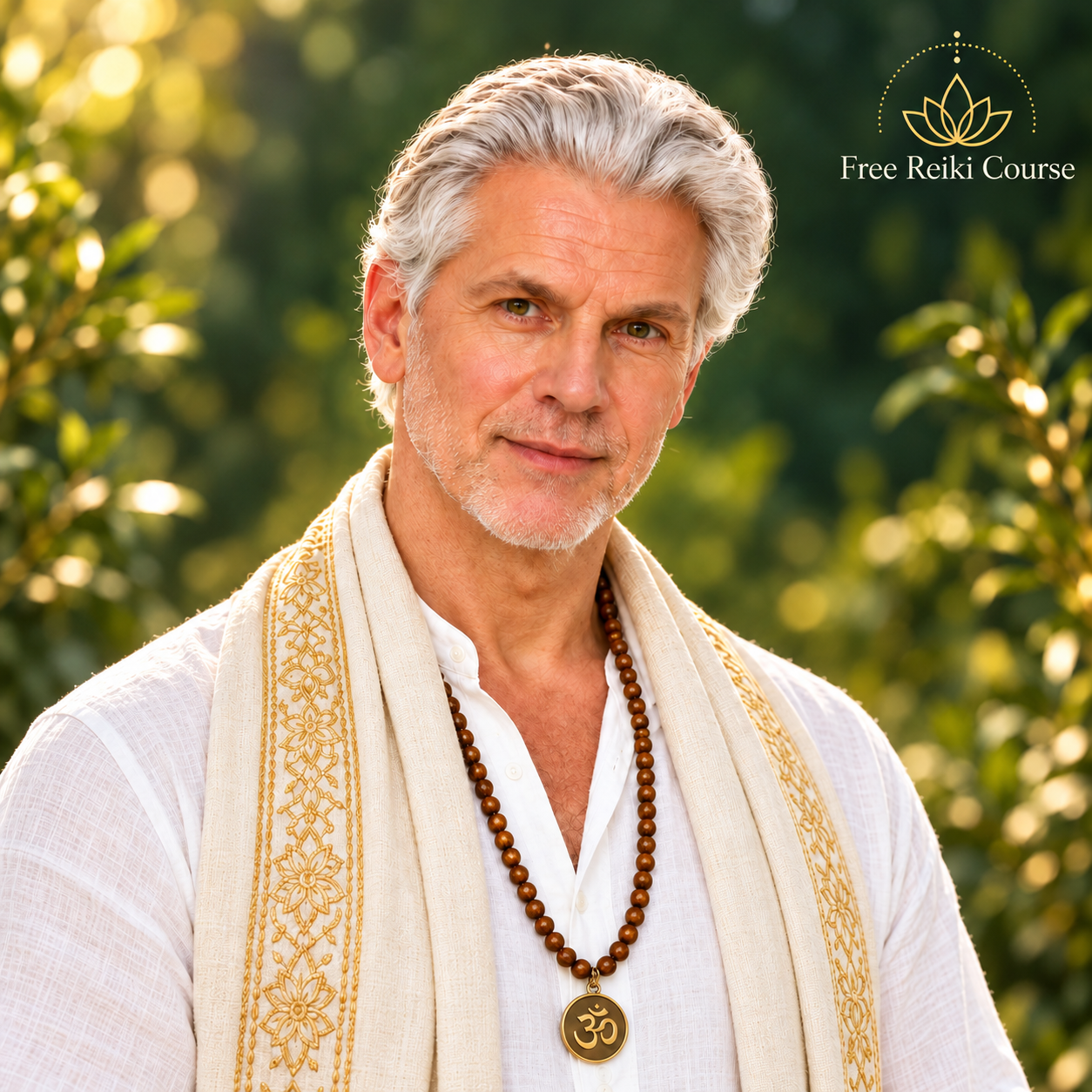
Who Is Christopher Goodman?
Christopher Goodman is the Reiki teacher at the center of Free Reiki Course and the International School of Reiki. He teaches traditional Usui Reiki through a three-level online program that begins with personal practice and progresses through symbols, distance-practice concepts and Master-level study.
According to Free Reiki Course, Goodman has taught traditional Usui Reiki since 2008. The site describes him as a Reiki Grandmaster and its current primary teacher, says every attunement on the current course is given by him, and credits him with writing course material and answering questions from learners.
Free Reiki Course also says its published articles are based on the same notes used in live classes. That connects Goodman's online writing with the school's teaching material and helps explain why his role extends beyond simply maintaining a website or presenting prerecorded lessons.
His role is closely connected to what makes Free Reiki Course distinctive. The main lessons, videos and PDF manuals are freely accessible. Attunements are available free on request, while certificates are optional paid records of study.
For Goodman, that means teaching through a model in which access to the actual Reiki lessons is not dependent on purchasing a qualification.
Who Is Christopher Goodman?
Christopher Goodman is the current primary Reiki teacher presented by Free Reiki Course and the International School of Reiki.
His publicly documented work centers on Reiki teaching rather than on the kind of personal biography available for a celebrity or mainstream public figure. Current Free Reiki Course pages provide substantial information about what Goodman teaches and does, but reliable public sources reviewed for this profile do not establish details such as his birthplace, age, formal education or career before Reiki.
What can be established is more relevant to his present role.
Free Reiki Course says Goodman has taught traditional Usui Reiki since 2008. The site's current homepage describes him as a Reiki Grandmaster, while some individual teaching pages use the simpler title Reiki Master. Rather than treating those labels as independently verified professional credentials, they are best understood as the titles currently used by the school itself.
Goodman is also presented as more than an instructor whose name appears at the top of a course.
The site credits him with:
- teaching traditional Usui Reiki;
- writing course material;
- answering questions from learners;
- guiding students through Levels 1, 2 and 3 / Master;
- and providing the attunements offered through the current course.
Students interested in the school and his teaching can learn with Christopher Goodmanthrough the current Reiki Academy.
That combination of teacher, writer and student contact gives Goodman a central role in Free Reiki Course today.
Christopher Goodman at a Glance
- Current role: Primary Reiki teacher at Free Reiki Course and the International School of Reiki
- Teaching tradition: Traditional Usui Reiki
- Teaching history: Since 2008, according to Free Reiki Course
- Titles currently used by the site: Reiki Grandmaster and Reiki Master
- Course structure: Levels 1, 2 and 3 / Master
- Teaching work: Lessons, course material, learner questions and attunements
- Learning model: Free lessons, videos and manuals, free attunements on request, and optional paid certificates
The clearest way to understand Goodman is therefore through his teaching work and his connection to the long-running course rather than through unsupported personal details.
Christopher Goodman's Reiki Teaching Since 2008
The International School of Reiki describes itself as established in 2008, and current Free Reiki Course material says Goodman has taught traditional Usui Reiki since that year.
Other pages on the site describe him as writing there since 2008 as well.
That places his involvement across a long period of online Reiki education.
The school itself has changed over time. Historical parts of the site refer to earlier Academy programs, Australian workshops, accreditation arrangements, bridging programs and a Diploma of Teaching. The current Reiki Academy explicitly distinguishes those older programs from the free online course available today.
That distinction is important.
It would be misleading to suggest that every historical qualification or program once connected with the site remains part of Goodman's current course. What has continued is the broader Reiki teaching project and Goodman's documented connection with it.
Today's structure is much simpler.
Students can begin with Level 1, follow the lessons and manual, progress through the other levels when ready and request an attunement without having to purchase access to the course itself.
Goodman's teaching therefore connects the history of the school with its present online model.
The Current Teacher Behind Free Reiki Course
A large online learning library can easily become impersonal.
Free Reiki Course contains material covering Reiki principles, hand positions, symbols, attunements, history, everyday practice, teaching and other related subjects. Without a recognizable teacher, a collection of that size could feel more like an archive than a school.
Goodman's presence gives it a clearer human point of reference.
His name appears throughout current teaching material, and recent pages carry his author byline. The site states that he writes the course material it provides and answers questions submitted by learners.
Students are encouraged to identify the lesson they are studying and explain what they are unsure about when contacting the school.
That creates a practical connection between learner and teacher even though most of the course is self-paced.
The current homepage makes Goodman's direct involvement particularly clear in relation to attunements. It states that every attunement on the course is given by Christopher Goodman.
The website may deliver lessons digitally, but the current program still identifies a person responsible for teaching, responding to questions and providing that part of the course experience.
That is an important reason Goodman can fairly be described as the teacher behind Free Reiki Course rather than simply its public face.
What Christopher Goodman Teaches
Goodman's current course focuses on traditional Usui Reiki.
The Usui system takes its name from Mikao Usui, the Japanese teacher associated with the development of Usui Reiki in the early 20th century. Historical material about Usui, including archival records and documents connected with his life, has been collected by the International Center for Reiki Training.
The program starts with personal practice before progressing into symbols, working with others, distance-practice concepts and Master-level study.
The structure puts the foundations first.
Level 1 is not presented merely as something students need to complete before moving to more advanced material. The current course treats first-degree Reiki as a practice that can be useful on its own.
Students are encouraged to spend time with the lessons, return to earlier material and develop familiarity through practice rather than rush through the levels.
This gives Goodman's teaching a different emphasis from an online program built primarily around obtaining a certificate as quickly as possible.
Readers deciding what to look for in an instructor can also see Washington Independent's guide to finding Reiki teachers and masters, which discusses questions about training, experience and teaching approach.
How Christopher Goodman's Three-Level Course Works
All three levels are currently available online. Students can use the lessons, videos and downloadable manuals without buying a certificate.
Level 1: Foundations and Personal Practice
Level 1 introduces Reiki principles, preparation, hand positions and the foundations of self-practice.
The emphasis is on beginning with the individual.
Students can become familiar with the ideas and practices taught by the school before deciding whether they want to continue to the next level.
Goodman's current material presents this foundation as something worth practicing in its own right rather than simply a preliminary step toward becoming a Master.
Level 2: Symbols and Broader Practice
Level 2 introduces traditional Reiki symbols including Cho Ku Rei, Sei He Ki and Hon Sha Ze Sho Nen.
It also expands into material on practicing with other people and what Reiki traditions describe as distance Reiki.
These concepts need appropriate context.
Symbols, Reiki energy and distance practice belong to the spiritual and teaching framework of Reiki. They should not be described as scientifically demonstrated mechanisms simply because they are part of the course.
Goodman's current material makes room for the traditional teaching while also placing clearer boundaries around medical and scientific claims.
Level 3 / Master: Advanced Study and Teaching
Level 3 moves into Master-level material, including the Dai Ko Myo symbol, attunement teaching and information for students considering teaching Reiki themselves.
The current course does not treat finishing the material or obtaining a certificate as sufficient preparation for teaching others well.
Students are encouraged to consider whether they understand the foundations, can explain them clearly, can respond responsibly to questions and recognize the limits of their own experience.
A certificate records learning. It does not by itself demonstrate professional competence.
Readers interested in how these stages are commonly organized can also explore Washington Independent's overview of Reiki certification levels.
Goodman's Teaching Model: Learn First, Certify Later
One of the strongest features of Christopher Goodman's current course is the separation between access to education and purchasing a certificate.
The main educational material is free.
Students currently have access to:
- Level 1, Level 2 and Level 3 / Master lessons;
- course videos;
- downloadable PDF manuals;
- the wider Reiki learning library;
- and attunements on request.
Certificates are optional paid purchases.
That matters because “free course” can sometimes describe little more than a free introductory lesson followed by a paywall.
That is not the current Free Reiki Course model.
Students can open all three levels without purchasing a certificate. The course page also states that no account is required to begin.
Someone can therefore explore Level 1, spend time with the material, decide whether the teaching approach suits them and continue only if they want to.
Certification comes later for students who want a record of their study.
The teaching itself remains accessible without it.
For Goodman, this creates a model in which learning comes before the transaction.
Christopher Goodman as a Reiki Writer
Goodman's contribution is also visible outside the main course.
Free Reiki Course has developed a substantial library covering subjects such as Reiki foundations, principles, hand positions, symbols, attunements, history, techniques and teaching.
Current articles throughout that library carry Goodman's name as author.
The site also describes him as someone who writes the course material it gives away and answers questions from learners.
That makes his role partly educational and partly editorial.
Maintaining a large learning resource over many years involves more than continually adding new pages.
Historical material has to be distinguished from the current program. Explanations need to remain understandable. Students need a clear path through a library that is much larger than the three formal course levels.
Current Free Reiki Course pages do this by placing the Level 1 to Master progression at the center and using the wider library for additional reading.
Goodman's authorship provides a recognizable connection between those resources.
Why Goodman's Free Attunements Matter
Attunement holds an important place in many Reiki traditions.
Within those traditions, an attunement is generally understood as an initiation associated with progression through Reiki practice. The spiritual meaning attributed to it differs among lineages and teachers.
Free Reiki Course currently makes a clear distinction between attunements and certificates.
Attunements can be requested without purchasing a certificate.
More importantly for understanding Goodman's role, the current Free Reiki Course homepage says that every attunement offered through the course is given by Christopher Goodman.
This is one of the most direct examples of his involvement with students.
The learning material can be accessed automatically through the website, but this part of the course remains connected to the teacher.
Students are given guidance for making a request and arranging the attunement rather than simply receiving one automatically alongside an online purchase.
That helps explain why Goodman's role extends beyond writing articles or appearing in course branding.
Online Reiki Education vs. Learning Face to Face
Christopher Goodman's work also illustrates the differences between online Reiki education and traditional face-to-face instruction.
The online model offers flexibility.
Students can study around their schedule, pause or replay material, keep manuals for reference and return to earlier lessons months later.
Geography becomes much less important.
A student does not need to live close to a particular teacher simply to explore the foundations.
Free access also allows someone to examine the teaching before deciding how deeply they want to pursue it.
In-person education has different strengths.
A teacher can observe someone directly, respond immediately to questions, adapt an explanation and provide feedback during a lesson. A classroom or workshop may also provide interaction with other students.
The two models therefore meet different needs.
For learners who value flexibility, independent study and permanent access to course material, Goodman's online approach can be attractive.
Someone who wants immediate observation, live group practice and extensive face-to-face interaction may prefer a local teacher.
The important point is not that one approach is universally superior.
Goodman's model provides another route into Reiki education.
Keeping a Long-Running Reiki Library Accessible
Over time, Free Reiki Course has developed into an extensive online Reiki learning resource, combining a structured three-level Usui Reiki course with downloadable manuals, videos and a large supporting library covering foundations, everyday practice, symbols, attunements, history and teaching.
That depth is useful, but it also creates an organizational challenge.
Readers need to know which material represents the present course, which pages provide supplementary information and which parts belong to the school's history.
The current structure attempts to make those distinctions clearer.
Historical Academy programs are separated from today's free online learning model. The formal Level 1 to Master pathway gives students a starting point. The larger library can then be used when they want to explore a particular topic more deeply.
Goodman's continued teaching and writing help connect those pieces.
Instead of functioning simply as a collection created years ago, the site continues to present him as an active teacher working within the material.
That may be one of his most important roles at the International School of Reiki: keeping a long-running body of Reiki teaching accessible while giving current students a clear route through it.
Christopher Goodman and Responsible Reiki Teaching
Reiki can involve spiritual ideas, personal experiences and claims about health, so responsible teaching requires a clear distinction between those areas.
The National Center for Complementary and Integrative Health, part of the U.S. National Institutes of Health, says Reiki has not been clearly shown to be effective for any health-related purpose. It also says there is no scientific evidence supporting the existence of the energy field proposed in Reiki practice.
That does not prevent someone from studying or practicing Reiki for personal, spiritual or cultural reasons.
It does mean that experiences during Reiki should not be treated as medical diagnosis or proof that a disease has been treated.
Goodman's current teaching material reflects that boundary.
Current Free Reiki Course pages describe Reiki as a complementary practice rather than a substitute for medical care. Recent teaching pages also emphasize consent, allow people to decline touch or particular positions, and warn against interpreting sensations during Reiki as evidence of illness or healing.
That is an important element of teaching responsibly in this field.
Goodman can teach traditional Reiki concepts while still distinguishing those concepts from established medical evidence.
The two do not need to be confused.
Why Christopher Goodman Matters to Free Reiki Course Today
Christopher Goodman is more than the name attached to an online Reiki course.
Free Reiki Course says he has taught traditional Usui Reiki since 2008. Today, the site presents him as its primary teacher, credits him with writing course material and answering student questions, and says he personally gives the attunements offered through the current program.
His work sits behind a structured three-level course and a much larger library built around Reiki practice and education.
The model he teaches through is also distinctive.
Students can begin with Level 1, work through the videos and manuals, move into Levels 2 and 3 / Master and request an attunement without paying to access the core teaching.
Certificates remain available to those who want a record of their study, but certification is not the gateway to the lessons.
That structure keeps the emphasis on learning and practice.
It also gives Goodman a role that extends beyond simply being an instructor.
He is the current teacher connecting a long-running Reiki school with the students using it today.
For a project with roots in 2008, that continuity matters.
Free Reiki Course is not simply an old library carrying Christopher Goodman's name. Its current pages present him as the teacher still writing within that library, responding to learners, giving attunements and guiding students through the course.
That is what makes Christopher Goodman the teacher behind Free Reiki Course today.
Jump to
Who Is Christopher Goodman?
Who Is Christopher Goodman?
Christopher Goodman at a Glance
Christopher Goodman's Reiki Teaching Since 2008
The Current Teacher Behind Free Reiki Course
What Christopher Goodman Teaches
How Christopher Goodman's Three-Level Course Works
Goodman's Teaching Model: Learn First, Certify Later
Christopher Goodman as a Reiki Writer
Why Goodman's Free Attunements Matter
Online Reiki Education vs. Learning Face to Face
Keeping a Long-Running Reiki Library Accessible
Christopher Goodman and Responsible Reiki Teaching
Why Christopher Goodman Matters to Free Reiki Course Today
Paolo Reyna
Author
Paolo Reyna is a writer and storyteller with a wide range of interests. He graduated from New York University with a Bachelor of Arts in Journalism and Media Studies.
Paolo enjoys writing about celebrity culture, gaming, visual arts, and events. He has a keen eye for trends in popular culture and an enthusiasm for exploring new ideas. Paolo's writing aims to inform and entertain while providing fresh perspectives on the topics that interest him most.
In his free time, he loves to travel, watch films, read books, and socialize with friends.
Iram Martins
Reviewer
Iram Martins is a seasoned travel writer and explorer with over a decade of experience in uncovering the world's hidden gems. Holding a Bachelor's degree in Tourism Management from the University of Lisbon, Iram's credentials highlight his authority in the realm of travel.
As an author of numerous travel guides and articles for top travel publications, his writing is celebrated for its vivid descriptions and practical insights.
Iram’s passion for cultural immersion and off-the-beaten-path adventures shines through in his work, captivating readers and inspiring wanderlust.
Outside of his writing pursuits, Iram enjoys learning new languages, reviewing films and TV shows, writing about celebrity lifestyles, and attending cultural festivals.
Latest Articles
Popular Articles